
Intrum is a debt collection company that buys debts or acts on behalf of an original creditor. When a letter bears its letterhead, the claimed debt may be old, assigned multiple times, and the amount displayed does not always correspond to what is actually owed. Before paying or ignoring a reminder, it is essential to understand what Intrum can legally do, and especially what it cannot do without an enforceable title.
Intrum amicable collection: what the law allows and what it prohibits
The vast majority of letters sent by Intrum fall under amicable collection. This phase has no binding value. Intrum can contact you by mail, phone, or email, but has no power of seizure as long as it does not hold an enforceable title (judgment, order for payment that has become final).
A commonly misunderstood point: the costs of amicable collection are generally the responsibility of the creditor, not the debtor. The DGCCRF reminds us of this. If Intrum’s letter mentions “file fees” or “collection fees” added to the initial amount, these sums are not automatically due. You can contest them in writing.
The formal notice sent by a collection agency must necessarily mention the name of the original creditor, the legal basis of the debt, the detailed amount (principal, interest, possible fees), and the company’s contact information. Any letter that is incomplete on these points can be contested. You will find information on Objectif Finance that details the checks to be made upon receiving a reminder.

Debt limitation: the period that can cancel the debt
Before responding to Intrum, the first check concerns the limitation of the debt. A time-barred debt can no longer be subject to judicial collection.
- For consumer credit, the limitation period is two years from the first unrectified payment incident.
- For a commercial debt or an enforceable title (judgment), the period can reach ten years depending on the nature of the act.
- For an invoice between a professional and a private individual, the common law period applies (five years in general).
A trap to be aware of: acknowledging the debt or making a partial payment interrupts the limitation. The clock then resets to zero. If you receive a letter from Intrum regarding an old debt, do not sign anything and do not send any transfer before verifying the dates.
The calculation of the starting point for the limitation depends on the type of contract. In case of doubt, a written response (registered letter with acknowledgment of receipt) requesting a copy of the original contract and a detailed statement of the debt is sufficient to suspend pressure without acknowledging anything.
Intrum’s seizure threat: distinguishing the letter from the enforceable act
Intrum’s letters regularly use alarming vocabulary: “seizure on account,” “imminent judicial procedure,” “final deadline.” This tone aims to provoke a quick payment.
Under French law, no seizure can be carried out without an enforceable title. As long as Intrum has not obtained a judgment or an order served by a judicial officer, the threat of seizure remains mere verbal pressure. A reminder letter, even threatening, does not carry the same weight as a payment order issued by a judicial officer.
What to do if a judicial officer contacts you
If you receive an official act (payment order, report of seizure-attribution), the situation changes radically. A payment order opens a period to settle, propose a payment plan, or contest before the enforcement judge.
In the case of a seizure-attribution on your bank account, the contestation period before the enforcement judge is one month from the notification of the act. This period starts from the official notification, not from the initial amicable reminder. After this month, contesting becomes much more difficult.
Order for payment: a judicial act not to be ignored
An order for payment served by a judicial officer is not just a simple collection letter. The opposition must generally be filed within a month following the service. This opposition suspends the execution of the order and requires the creditor to demonstrate the validity of their claim before the court.
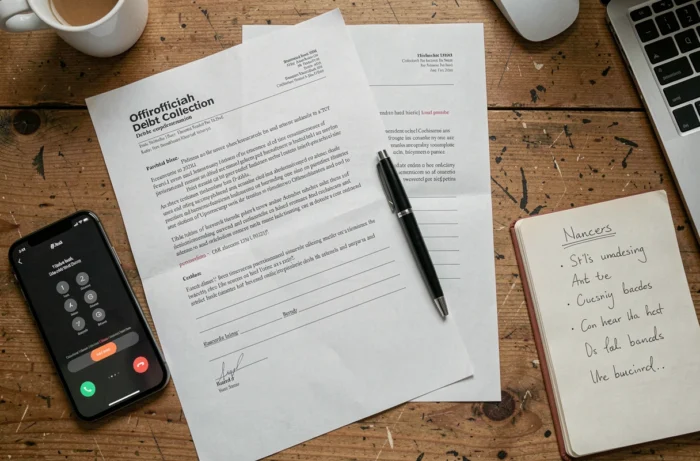
Contesting an Intrum reminder: the concrete procedure by registered mail
Written contestation remains the most effective means to protect your rights. A phone call leaves no actionable trace. A registered letter with acknowledgment of receipt constitutes an opposable proof.
Your letter should request three specific elements:
- A copy of the original contract or invoice, signed by the debtor, proving the existence of the debt.
- The deed of assignment of the debt, if Intrum has purchased the debt from the original creditor, to verify its standing to act.
- The detailed statement distinguishing the remaining capital due, the interest, and any fees claimed.
If Intrum does not provide these documents, it does not prove its standing to act. An imprecise or global debt assignment slip (without individualized identification of your debt) constitutes a serious defense, including in the event of subsequent judicial proceedings.
Keep all documents: received letters, copies of your sends, acknowledgments of receipt. In case of harassment (repeated calls, pressure on acquaintances, visits to your home), these elements can form the basis for a report to the DGCCRF or a complaint for abusive practices.
The most protective reflex in response to an Intrum reminder remains to pay nothing and sign nothing until you have received complete proof of the debt and verified that the limitation period has not expired. Intrum’s silence in response to a request for supporting documents speaks louder than its reminders.