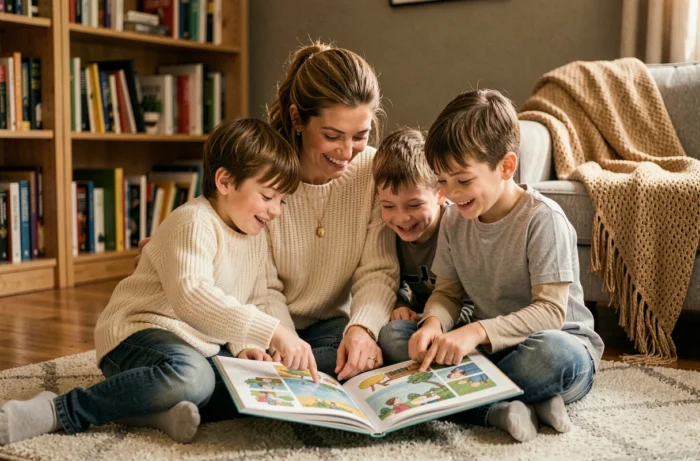
Shared reading in the family is not limited to the bedtime ritual for toddlers. Teachers observe better academic performance in children who are regularly read to, thanks to a broader vocabulary and improved understanding of oral instructions. We recommend maintaining this practice well beyond the stage of independent reading, including in primary school.
Continuing to read aloud after the first grade: an underutilized lever
Many parents stop reading aloud as soon as the child can decode on their own. Tiffany Ohlson, a professor of education at Flagler College, emphasizes that continuing shared reading exposes the child to more complex texts and vocabulary that they would not spontaneously choose. This distinction makes all the difference between a functional reader and a reader who can explain their reasoning.
Specifically, an eight or nine-year-old child reading alone often sticks to short stories suited to their decoding level. By reading aloud a long tale or a children’s novel, the parent brings them into a higher level of comprehension, where syntax and vocabulary work without conscious effort.
The catalogs available on histoire-enfant.fr allow for selecting stories by age group, including for beginner readers who still benefit from accompanied reading.
What this changes in the choice of children’s stories
If reading aloud continues, the family corpus expands. We can integrate traditional tales with long narrative structures (journeys, embedded stories) rather than sticking to short picture books. The tales of Perrault or stories of African and Asian origin, often rich in twists and dialogues, lend themselves particularly well to this shared oral format.
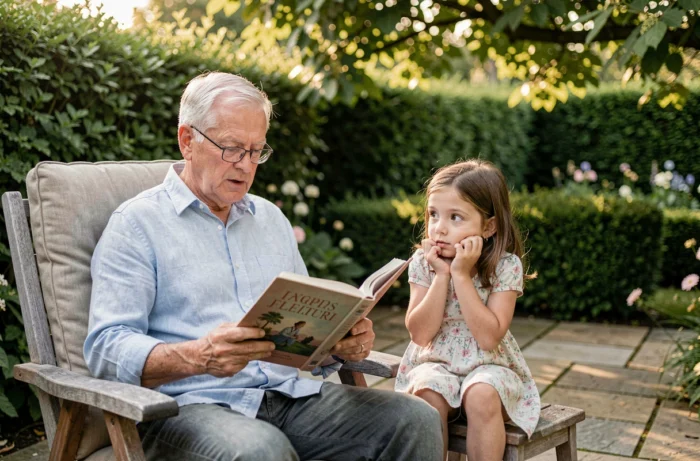
Audio stories for children: an alternative to screens, not a replacement for books
A new generation of youth audio platforms explicitly positions itself as an alternative to screens. Services like Kidsono claim this niche: disconnecting children from screens while maintaining narrative access. The audio format has its merits, but we observe that it serves a different function than shared reading.
Listening to an audio story is a solitary activity. The child receives a narrative without interaction, without the possibility of asking a question about an unknown word, without the physical contact of the book or the presence of the parent. Audio is suitable for car rides and waiting times. It does not replace the moment when an adult reads, pauses, comments on an illustration, or rephrases a passage.
Criteria for choosing a relevant children’s audiobook
- The duration should match the child’s attention span: short stories work better before age six, while chapter stories are suitable afterward
- The quality of narration is as important as the text: an actor who modulates their voice for each character keeps attention much longer than a monotone reading
- The content should also exist in paper or digital form, so the child can return to the text and illustrations after listening
Traditional tales or contemporary stories: adapting the choice to the reader’s age
The traditional tale remains the most effective narrative foundation for structuring the imagination. The stories of Grimm, Andersen, or Middle Eastern tales operate on proven narrative patterns: quest, trial, resolution. These structures help the child anticipate, formulate hypotheses, and understand causality in a narrative.
Contemporary stories bring something different. They talk about everyday life, social emotions (jealousy, fear of school, the arrival of a little brother), and use familiar vocabulary. We recommend not opposing the two but alternating between them.
Selection grid by age
| Age group | Type of suitable story | Preferred format |
|---|---|---|
| 2-4 years | Short picture books, journey tales, repetitive stories | Illustrated book, read aloud |
| 5-7 years | Traditional tales, first adventures, animal stories | Long picture book or first novel, shared reading |
| 8-10 years | Children’s novels, world legends, chapter stories | Paper or audio book, independent + shared reading |
A common pitfall is moving too quickly to independent children’s novels. A seven-year-old may love being read a twenty-minute tale, even if they can read simpler texts on their own. The reader’s age does not always correspond to the age of oral comprehension, which is often higher.
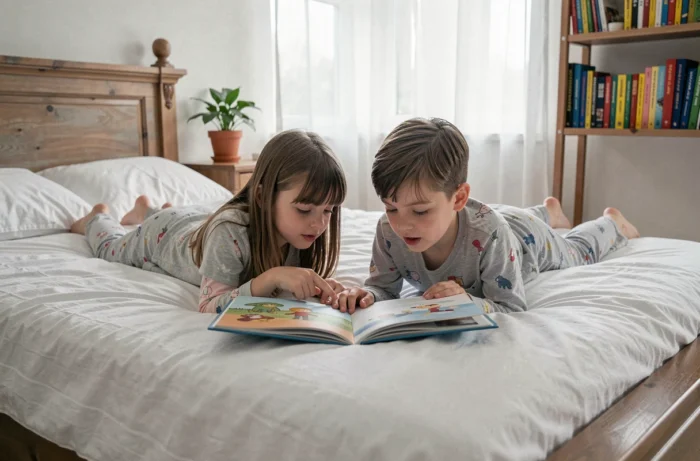
Building a lasting family reading ritual
The ritual does not depend on the choice of book. It relies on regularity and the absence of pressure. A child who associates reading with a school obligation will disengage. A child who chooses their story, who can ask for the same one for the tenth time, who sees their parents reading themselves, develops an emotional connection to the book.
- Setting a short but daily time slot works better than a long weekly session
- Allowing the child to choose from a limited selection avoids choice paralysis while preserving their autonomy
- Varying formats (picture book, audio tale, digital book) maintains curiosity without turning reading into a routine
- Rereading the same story reinforces vocabulary retention and understanding of narrative structures, especially before age five
The best children’s stories are not necessarily the newest or most awarded. They are the ones the child requests, those that provoke a question, a laugh, or attentive silence. The role of the reading parent is to suggest, not impose, and to remain available for this shared reading as long as the child finds joy in it.