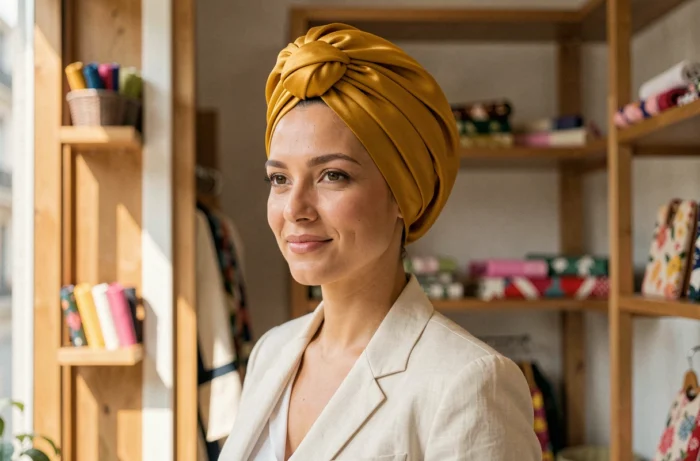
A well-chosen turban transforms an ordinary outfit into a bold silhouette. Whether to protect your hair, add volume to a hairstyle, or simply assert your style, turbans and head accessories are making a comeback with shapes, materials, and colors that adapt to all contexts.
Technical fabric or natural fibers turban: what the material really changes
Have you ever noticed that a turban worn for two hours can become uncomfortable depending on the fabric? The material determines everything: support, breathability, knot retention, and even the longevity of the accessory.
Cotton remains the most versatile choice. It absorbs sweat, washes easily, and retains its shape after several uses. A tightly woven cotton holds better in place than a fine jersey, which tends to slip on smooth hair.
Bamboo fibers offer superior softness compared to classic cotton. They are particularly suitable for sensitive or weakened scalps. Their absorption capacity exceeds that of cotton, making them suitable for warm seasons.
Synthetic materials (polyester, elastane) provide elasticity and facilitate tying. In return, they retain heat. A cotton-elastane blend often represents the best compromise between comfort and support. To explore different models and materials, you can visit the Madame Turban website and compare the offered compositions.
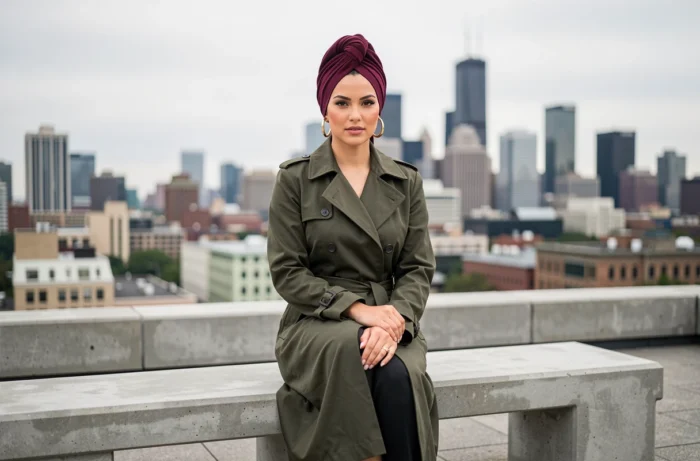
Turban, headband, or scarf: choosing the shape suitable for your hairstyle
The confusion between these three accessories is common. Each serves a different purpose and visual effect.
- The covering turban envelops the entire head. It structures the silhouette and works well on both folded long hair and short or absent hair. Its volume creates a focal point that draws the eye to the face.
- The headband is limited to the forehead and the top of the head. It keeps the hair back without hiding it. On natural or curly hair, it adds a structured touch without flattening the volume.
- The tied scarf offers the greatest freedom of style. Folded in a triangle, twisted, or draped around a bun, it reinvents itself with each use. Its versatility makes it an ideal travel accessory.
For a wedding or a dressed-up event, a satin or silk turban with a central jewel (brooch, pearl, miniature crown) adds a glamorous effect without being overdone. The dressed-up turban replaces an elaborate hairstyle with fewer constraints.
Adapting the shape to the face
A round face gains length with a turban tied high, creating verticality. An elongated face is balanced with a wide headband worn low on the forehead. These simple adjustments change the perceived proportion without any intervention on the hair.
Head accessories and everyday style: three concrete associations
Wearing a turban or scarf is not just about putting it on. The head accessory functions as a coordinating piece, not as an isolated addition.
Casual outfit
A solid color cotton headband (ochre, terracotta, navy blue) placed on loose hair, paired with an oversized shirt and jeans. The headband matches the color of a detail in the outfit, such as a belt or bag. The overall look remains understated, with the headband structuring the look without formalizing it.
Office outfit
A textured fabric turban (jacquard, thick linen) in a neutral tone. Worn with a blazer, it replaces a necklace and draws attention to the upper body. Opt for a discreet knot on the side rather than on top for a professional appearance.
Evening or wedding outfit
A silk scarf tied as a turban, adorned with a head jewel or vintage brooch. The satin captures light and creates an immediate dressed-up effect. On a monochrome dress, the turban becomes the centerpiece of the silhouette.
Turban and textile regulation: what changes for accessories in Europe
Since July 19, 2026, large companies can no longer destroy their unsold clothing and accessories, including scarves, hats, and turbans. This obligation arises from the European regulation on the eco-design of sustainable products (ESPR, EU regulation 2024/1781).
In practice, brands must organize the donation, resale at reduced prices, or recycling of their stocks. For customers, this means more end-of-line models available at reduced prices, and enhanced traceability regarding product composition.
The digital textile passport, expected from 2027, will allow comparisons of turbans based on environmental criteria. Each textile accessory will be associated with a sheet accessible via QR code, indicating composition, origin, durability, and recycling possibilities. This system will transform the way a turban is chosen by adding objective data to aesthetic appreciation.
Small artisanal brands, often already transparent about their materials and manufacturing, will be ahead of this requirement. Checking the composition before purchase becomes as useful a reflex as choosing the color.
The turban remains one of the few accessories capable of radically altering a silhouette without touching the hair or makeup. The choice of material determines comfort, the shape dictates style, and the new European requirements will soon ensure unprecedented transparency about what you are actually wearing on your head.