
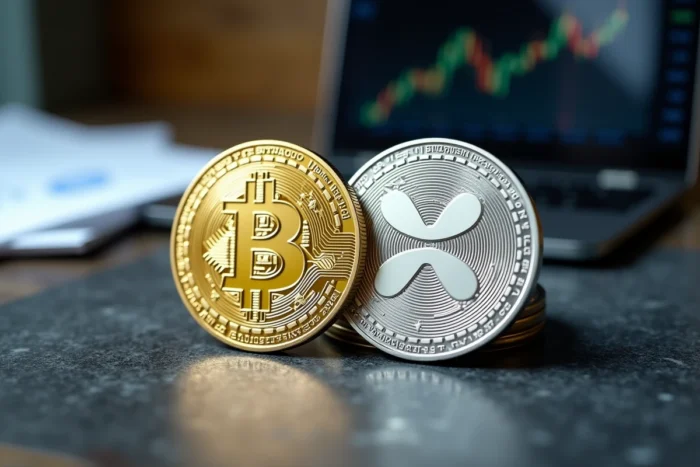
Bitcoin and XRP share the same technological foundation, the blockchain, but their market trajectories and use cases diverge to the point of not targeting the same investors. Comparing Ripple and Bitcoin is akin to opposing two philosophies: a decentralized store of value versus a protocol designed for cross-border payments. What indicators can measure their respective weight in the crypto market in 2026?
Market Capitalization, Speed, Consensus: The Numbers Face to Face
| Criterion | Bitcoin (BTC) | XRP |
|---|---|---|
| Market Capitalization | Approximately $1.45 trillion (1st place) | Approximately $87 billion (5th place) |
| Share of Total Crypto Market Capitalization | Approximately 58% | Several percent |
| Consensus Mechanism | Proof of Work (mining) | Ripple protocol consensus algorithm (validators) |
| Maximum Supply | 21 million BTC | 100 billion XRP (deflationary supply through fee destruction) |
| Main Use Case | Store of value, digital gold | Fast and low-cost cross-border payments |
The table reveals a capitalization gap of about 1 to 17. Bitcoin alone accounts for more than half of the total value of the cryptocurrency market. XRP, despite its fifth place, remains a niche asset by comparison.
Understanding the differences between Ripple and Bitcoin requires going beyond just the unit price, which does not reflect either capitalization or market dynamics.
Bitcoin Dominance: A Slow Erosion That Benefits No Single Rival
Bitcoin’s dominance in the crypto market was around 87% in 2014. It now hovers around 58% in 2026. This decline, spread over more than a decade, reflects the proliferation of blockchain projects and the arrival of Ethereum, stablecoins, and other altcoins in institutional portfolios.
The key point: no altcoin, including XRP, has captured the share lost by Bitcoin on its own. BTC’s dominance declines in small increments, collectively absorbed by dozens of competing projects. The scenario of a “flippening” where a single asset would dethrone Bitcoin is not emerging in the current data.
XRP: The Only Altcoin in the Top 10 for 13 Years
According to a CoinGecko report, XRP is the only altcoin to have remained in the top 10 for 13 consecutive years. This market milestone distinguishes XRP from all other Bitcoin competitors, many of which have fallen from the top spots after one or two bullish cycles.
This persistence suggests a form of structural resilience. Projects once considered serious alternatives to Bitcoin (Litecoin, Dash, NEM) have lost their rank. XRP has held its ground, supported by a concrete use case in interbank payments and the ecosystem developed by Ripple Labs.
Consensus and Decentralization: Two Incomparable Models
Bitcoin relies on proof of work. Thousands of miners around the globe validate transactions by solving cryptographic calculations. This mechanism ensures maximum decentralization, at the cost of high energy consumption and limited processing speed.
XRP operates with a network of validators approved by Ripple Labs. Transactions are confirmed in a few seconds, compared to several minutes for Bitcoin. Fees are negligible.
- Bitcoin prioritizes security and resistance to censorship: each block is immutable, and the network does not depend on any central entity.
- XRP prioritizes speed and cost: the protocol is designed to handle a high volume of cross-border payments without congestion.
- The compromise of XRP on decentralization (selected validators) remains a point of friction for part of the crypto community, which believes that XRP’s governance is too centralized for a public blockchain.
This technical divide explains why the two assets do not compete for the same clientele. Bitcoin attracts investors seeking long-term macroeconomic coverage. XRP appeals to financial institutions looking to reduce the cost and time of international transfers.

Ripple and Cross-Border Payments: A Separate Market
The CEO of Ripple positions XRP as a liquidity bridge asset, intended to replace the nostro and vostro accounts that banks maintain abroad. The argument rests on a gain in speed and a reduction in fees compared to traditional networks like SWIFT.
Bitcoin has never targeted this segment. Its architecture, with limited block sizes and longer confirmation times, does not make it competitive for micropayments or instant transfers between currencies. Bitcoin and XRP are not fighting for the same market.
XRP’s Deflationary Supply: A Mechanism Often Misunderstood
Each transaction on the XRP Ledger destroys a tiny amount of XRP as a fee. The total supply, initially set at 100 billion tokens, therefore gradually decreases. This deflationary model is the opposite of that of fiat currencies, but also differs from Bitcoin’s halving, which reduces the rate of new BTC creation approximately every four years.
- Bitcoin limits its supply through programmed scarcity: 21 million BTC, never more.
- XRP reduces its supply through gradual destruction with each transaction.
- Both mechanisms aim to contain inflation, but through opposing logics.
Which Asset Truly Dominates the Crypto Market
In terms of market capitalization, Bitcoin has never been threatened by XRP. The gap is measured in trillions of dollars. In terms of longevity in the ranking of major cryptocurrencies, XRP shows a consistency that most altcoins have never achieved.
The question “Ripple or Bitcoin” is based on a common misunderstanding. These two assets do not serve the same function. Bitcoin remains the benchmark asset in the crypto market due to its capitalization and institutional adoption. XRP occupies a distinct place, focused on payments and interbank liquidity, with a market resilience proven over more than a decade.