
An organizational calendar refers to any medium that structures tasks, deadlines, or time slots over a defined period. The form varies (wall-mounted, digital, paper), but the function remains the same: to make visible what needs to be done, and when.
The choice of the right format depends less on personal preferences than on the type of work to be organized. A freelancer managing deliverables does not have the same constraints as a team split between office and remote work. Understanding the different types of organizational calendars allows one to adopt the one that truly fits their rhythm, rather than forcing their days into an unsuitable model.
Contextual calendar and hybrid work: the angle that traditional schedules ignore
Daily, weekly, or monthly schedules answer a simple question: what to do and when. With the generalization of hybrid work, another question arises: where to work and with whom.
In 2024, Microsoft launched Places, a calendar extension that integrates the location of colleagues, space occupancy, and days present in the office. The stated goal is to transform the calendar into a tool for spatial coordination, not just temporal.
This type of contextual calendar does not replace a task schedule. It overlays it. A collaborator can check their weekly schedule for deliverables, then verify on a contextual calendar if the people they need to collaborate with will be physically present on the same day.

This additional layer changes the logic of organization: instead of simply distributing tasks over time, one also arbitrates between locations based on planned interactions. For teams alternating between in-person and remote work, this is a concrete lever for coordination.
Time blocking vs. task list management: two calendar logics
Two main approaches structure the daily use of an organizational calendar. The first, task list management, involves creating an inventory of what needs to be done, then checking off items throughout the day. The second, time blocking, assigns a fixed time slot in the agenda for each task.
The difference is not cosmetic. A task list allows the choice of when to execute tasks, which suits less fragmented days. Time blocking, on the other hand, locks in time slots and protects concentration periods from interruptions.
When time blocking provides real gains
Time blocking shows its usefulness in jobs with a high cognitive load, where frequent interruptions degrade work quality. By reserving a two-hour block for a complex task (writing, analysis, development), one reduces the cost of switching attention between subjects.
- Creative or analytical tasks benefit from being grouped into long slots, without interspersed meetings.
- Short administrative tasks (emails, approvals, follow-ups) are better handled in batches, during a dedicated slot at the end of the morning or afternoon.
- Recurring meetings deserve to be concentrated on one or two days to free up entire days for production.
Without this block discipline, the calendar fills up with meetings and foundational tasks migrate to the evenings. Time blocking reverses this dynamic by first establishing deep work slots, then placing meetings in the remaining spaces.
Limits to be aware of
Time blocking becomes counterproductive when it is too rigid. A day sliced into thirty-minute chunks, without margin, collapses at the first unforeseen event. Allowing fifteen to twenty-minute buffers between blocks absorbs delays without derailing the rest of the day.
Shared team calendar: synchronization and collective visibility
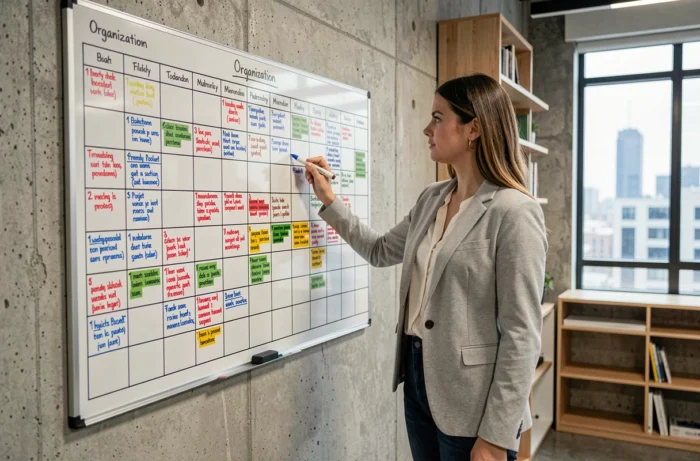
An individual calendar organizes one person’s work. A shared team calendar synchronizes availability, project deadlines, and absence periods on a common view. These are two complementary tools, not interchangeable.
The value of a shared calendar lies in the visibility it offers. When each team member can see the occupied slots of others, planning meetings or collaborative work sessions takes seconds instead of generating back-and-forth emails.
- Project deadlines (deliveries, reviews, milestones) appear on a unique calendar, accessible to all contributors.
- Holidays and absences are visible in advance, allowing for anticipation of workload redistribution.
- Common availability slots facilitate meeting planning without external polling tools.
The classic pitfall of a shared calendar is information overload. When everyone adds their individual tasks, the overall view becomes unreadable. Reserving the shared calendar for collective events and keeping personal tasks on an individual schedule maintains clarity.
Convergence of tasks, agenda, and collaboration: the all-in-one calendar
The market for productivity tools is evolving towards platforms that merge task management, agenda, and collaboration into a single interface. Rather than juggling between a to-do tool, a calendar, and messaging, these platforms combine all three functions.
This convergence addresses a real problem: the fragmentation of information across multiple applications. When a task is created in one tool, its deadline noted in another, and its discussion held in a third, the risk of information loss increases with each transfer.
An all-in-one calendar displays the task, its deadline, associated comments, and the blocked time slot in the agenda, all in one place. This approach reduces the time spent searching for where information is located, a significant time loss identified by several industry studies in digital work environments.
The choice between an integrated ecosystem and a combination of specialized tools depends on the size of the team and the complexity of the projects. For a single person, a calendar paired with a task list is sufficient. For a project team with dependencies between deliverables, a unified platform eliminates daily frictions.
The most effective organizational calendar is not the most comprehensive; it is the one whose granularity matches the actual work. A format that is too simple leaves blind spots, while a format that is too detailed becomes a task in itself to maintain. Testing a format for two weeks before adopting it remains the most reliable way to ensure it holds up over time.