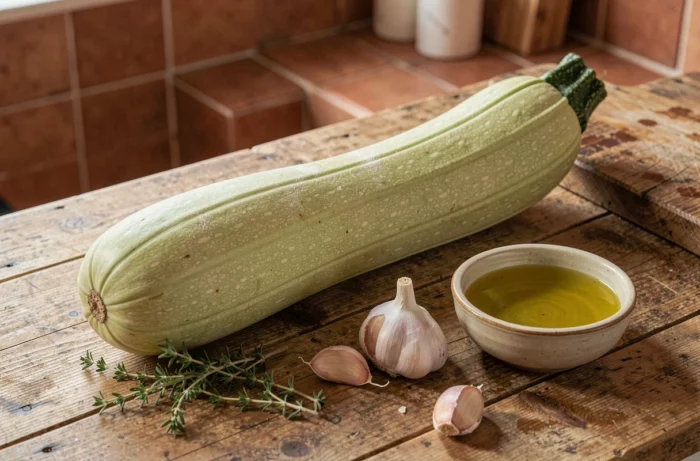
When you come home late and a long squash from Nice has been sitting on the countertop for weeks, the frying pan remains the quickest solution to turn it into a real dish. This storage vegetable, capable of lasting several months whole in a cool, dry place, is just waiting for this kind of rushed evening to reveal its orange flesh with a musky flavor.
Preparing the long squash from Nice before frying: skin, cutting, and thickness
The first constraint is the size of the vegetable. A long squash from Nice can reach up to a meter in length, with a swollen base that contains the seeds. Start by cutting the cylindrical part (the most practical for frying) and reserve the base for a soup or gratin later in the week.
Regarding peeling, opinions vary. If the squash is young and the skin gives easily under the nail, keeping the skin improves cooking hold and increases the fiber and antioxidant content, provided the vegetable is well washed. For a more mature specimen with thick skin, a standard peeler is not enough: use a knife, laying the squash flat for safety.
For even cooking in the frying pan, aim for uniform pieces. Two options work well: half-rings of half a centimeter for quick cooking with crispiness, or thicker cubes for a melting result that requires covering the pan. If you’re looking for an express recipe for long squash from Nice for a weeknight, the thin half-rings remain the most effective choice.

Frying: adjusting the heat for the type of evening dish
Most recipes provide a single cooking time, without specifying that the result changes radically depending on the intensity of the heat. In practice, we distinguish two approaches depending on what we want on the plate.
Quick frying over high heat for a crunchy side dish
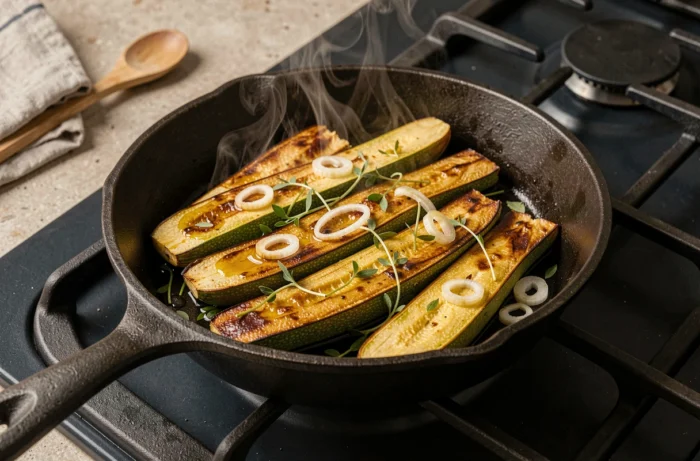
Heat the olive oil in a large frying pan, then lay the thin slices in a single layer. Do not stack the pieces: this is the condition for achieving a nice color. Let them sear for a few minutes on each side without too much stirring.
The result yields pieces golden on the outside, still slightly firm in the center. This type of cooking is suitable when the squash accompanies a main dish (fish, fried egg, grains) and you want some bite.
Covered cooking over low heat for a melting main dish
To turn the squash into a main dish, we work differently. Sauté the cubes with pressed garlic, add a spoonful of tomato paste or a splash of cream, then cover and lower the heat. The squash releases enough water to simmer gently without adding liquid.
Covering the pan transforms the texture from crunchy to melting in about half an hour. You achieve a consistency reminiscent of oven-roasted squash, without having preheated anything.
Seasonings that work with the musky flavor of this squash
The flesh of the long squash from Nice has a naturally sweet and musky taste, more pronounced than that of a regular zucchini. You can play on two registers.
- Mediterranean register: olive oil, garlic, fresh thyme, a drizzle of lemon juice at the end of cooking. The acidity enhances the sweet side without masking it.
- Spicy register: ground coriander, sweet chili flakes, tomato paste, chopped dill added off the heat. This combination gives a complete dish with bread or rice.
- Creamy register: a spoonful of fresh cream or light béchamel poured at the end of cooking, grated parmesan on top. The musky flavor of the squash pairs well with dairy fat.
In any case, salting at the beginning of cooking speeds up water release, which alters the final texture. If you want crispiness, salt at the end of cooking. For melting, salt from the start.
Managing quantity: cooking a large squash without wasting
One of the concrete advantages of the long squash from Nice is that you can cut just a section and wrap the rest. The cut part keeps for a few days in the refrigerator, wrapped in film or a damp cloth. The remaining intact squash continues its life as a storage vegetable in the cellar.
For a dinner for two, a section of about twenty centimeters is more than enough. The flesh is dense, and the squash reduces little during cooking compared to a regular zucchini.
- Upper section (cylindrical, few seeds): ideal for frying, easy to cut into rings or uniform cubes
- Swollen base (the part with the seeds): more suitable for a gratin, soup, or purée, as the central cavity complicates cutting into uniform pieces
- Skin removed: do not throw it away if it is thin; you can fry it separately as chips with a bit of salt and oil
This segmented cutting logic makes the long squash from Nice a cost-effective vegetable for several meals from a single purchase. You cook a section on Monday night in the frying pan, another in soup on Wednesday, and the base goes into a gratin over the weekend.
The last point to keep in mind: the long squash from Nice gains in musky flavor after a few weeks of storage. A freshly harvested specimen from the garden will be sweeter, almost bland. Letting the squash ripen at room temperature for a few weeks before cooking concentrates the aromas and makes the frying tastier, with no extra effort in the kitchen.