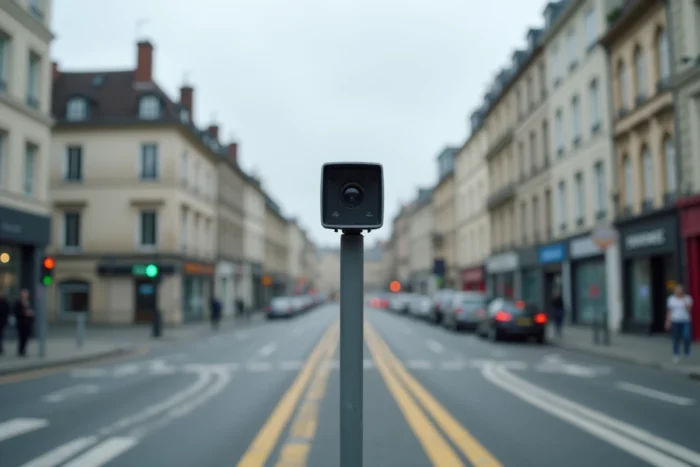
We drive in the city, stop at the light, and see a box mounted on a pole a few meters from the intersection. Red light crossing radar, video-verbalization camera, or simple traffic sensor to regulate traffic: three very different devices sometimes coexist at the same intersection. Knowing how to distinguish them changes the way we understand urban road control.
Three devices at the same intersection: what each box really does
The most common case remains the red light crossing radar. It is recognized by its rectangular box installed on a pole about three meters high, positioned about twenty meters downstream from the traffic light. Its role is strictly automated: two photos are taken when a vehicle crosses the light effect line (LEF), and then when it continues past the light. If both images confirm the violation, the infraction is recorded without human intervention.
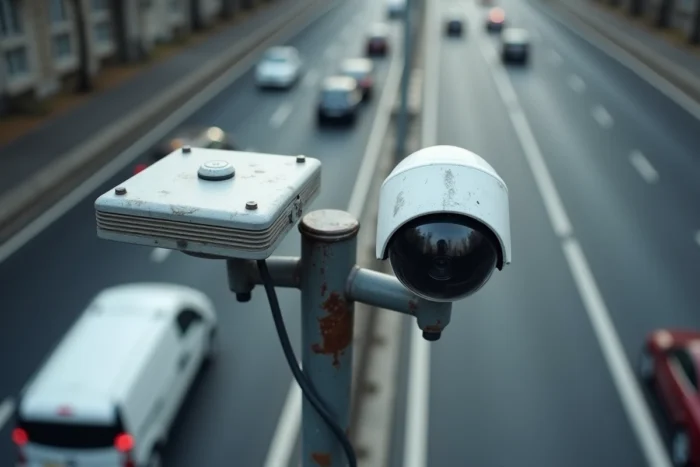
Next to this radar, we increasingly find video-verbalization cameras. These do not flash. They transmit a video feed to a municipal control center where an operator, sometimes assisted by an algorithm, remotely observes various infractions: driving in a bus lane, ignoring a no-entry sign, crossing a solid line.
Understanding the difference between a camera and a red light radar prevents confusing a purely repressive device with a broader surveillance tool.
The third device is the traffic sensor. It takes the form of electromagnetic loops embedded in the roadway or small modules mounted at height. Its function is exclusively regulatory: counting vehicles, measuring flow, adjusting the duration of green lights. No ticket comes from it.
Urban radar and AI: multi-violation control at red lights
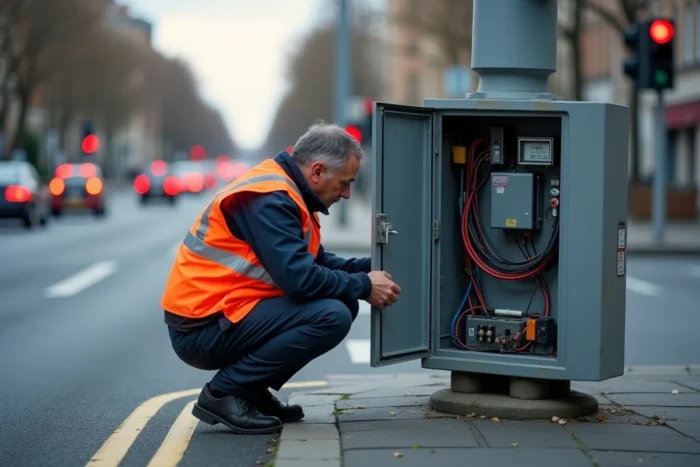
Since 2025-2026, a new type of device further blurs the lines. The so-called “smart” urban radars combine high-definition cameras and artificial intelligence. A single box placed near a light can detect red light violations, but also detect a phone being held, the absence of a seatbelt, or failure to maintain safe distances, sometimes in a single sequence of shots.
In practice, this means that a driver caught running a red light can receive multiple distinct violation notices from the same incident. Feedback on this point varies by city and installation, but the trend towards consolidating functions into a single device is confirmed by recent deployments.
What distinguishes these urban radars from a standard surveillance camera
The municipal surveillance camera films continuously and is not intended to automatically generate tickets. The urban radar, on the other hand, is certified to produce legally usable evidence of violations. The difference lies in the certification of the device and in the processing chain: the radar sends the images to the Automated Center for Road Traffic Violations (CACIR), while the video-verbalization camera goes through a sworn agent who manually validates each observation.
Signage and visual indicators to recognize a red light radar
On the ground, several elements allow for the identification of a crossing radar even before passing the light.
- A specific “radar control” sign must be installed upstream of the intersection, in accordance with French regulations on the signage of fixed radars.
- The light effect line (LEF), marked with dashed lines on the roadway, indicates the triggering threshold. Stopping straddling it already constitutes a violation.
- The box is oriented towards the roadway and not towards the sidewalk, at an angle that allows photographing the rear license plate of the vehicle and the light in the same frame.
- Video-verbalization cameras, on the other hand, are often more discreet, installed higher on public lighting poles, and do not come with a radar sign.
Traffic sensors, for their part, are the most discreet of all. Inductive loops are invisible (buried under the asphalt), and aerial sensors resemble small white or gray cylinders with no apparent optics.
Video-verbalization in the city: infractions monitored without flash or booth
Video-verbalization has become widespread in major French urban areas. The principle is simple: cameras connected to an urban supervision center film sensitive areas. An agent observes the infraction on screen, identifies the vehicle by its plate, and issues a ticket remotely.
This system covers infractions that the crossing radar cannot detect:
- Parking or driving in reserved lanes (buses, bicycles, carpooling)
- Ignoring a no-entry sign or a pedestrian zone
- Crossing a solid line outside an intersection
- Use of a phone while driving detected by image analysis, in the most recent installations
The absence of a flash makes these cameras practically undetectable for the driver. The ticket is received by mail without any signal being perceived at the time of the infraction.
Technical margin and contestation
For red light crossing radars, a technical margin exists. The device only triggers when the light has been red for a certain period, which excludes passages at the very end of orange. In case of contestation, one can request the images from CACIR: both photos must clearly show the vehicle before and then after the LEF, with the red light visible. If any of these elements are missing, the case can be contested.
For video-verbalization, the procedure differs: it is the timestamped video capture and validation by the sworn agent that are authoritative. Contesting a video-verbalization requires challenging the identification of the vehicle, which is more difficult than pointing out a technical defect in a radar image.
The landscape of road control in the city is no longer limited to a single type of device. Automatic radar, operator-controlled camera, regulatory sensor, multi-violation urban radar: each box has its own logic. Confusing them is to misjudge what is actually monitored at each intersection.