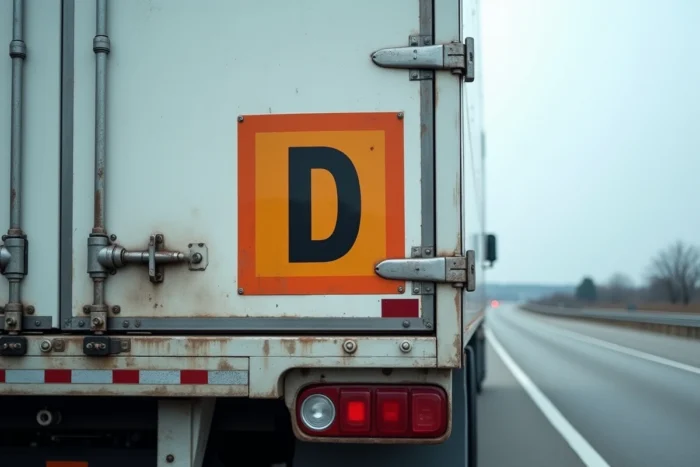
You are driving on a national road and you spot a large white “D” on a black background, fixed to the back of a heavy truck. A few kilometers later, an oval white sticker also displays a “D” on the door of a truck registered in Germany. And in the cabin of your own vehicle, the gear selector also indicates “D” for Drive.
Three contexts, three meanings, one letter. Understanding what each “D” corresponds to avoids misinterpretations that can be costly, both on the road and during a check.
Three “D”s on the same truck: the confusion that persists between size, country, and automatic transmission
The problem arises from a mental shortcut. Many drivers associate the “D” with a single function, the one they encounter most often. A driver accustomed to automatic transmissions immediately thinks of the Drive position. A French truck driver identifies the size sign. A cross-border commuter recognizes the country code Deutschland.
These three markings have no regulatory link to each other. Their location on the vehicle is the only reliable criterion for distinguishing them. A square sign fixed high up, visible from the front and back, refers to size. An oval white sticker on the back of the chassis indicates the country of registration. The “D” on the gear lever belongs to the vehicle’s internal mechanics.
When discussing the letter D on trucks, most sources address only one of these meanings. This partial approach fuels confusion instead of resolving it.
The meaning of “D” strictly depends on its location on the vehicle. Confusing the size sign with a country code may seem trivial, but the consequences are concrete: a driver who does not understand they are approaching an oversized convoy will not take the appropriate overtaking precautions.

Size sign “D”: what regulations impose on wide vehicles
You may have noticed these square signs, often slightly dirty, fixed high up on agricultural machinery or public works trucks? This is the size “D”. Its function is to alert users that a vehicle exceeds the standard authorized width.
Conditions for displaying the D sign
The rule is as follows: any vehicle whose width exceeds 2.50 m must display this sign. It appears as a square showing a white “D” on a black background. It must be visible from the front and back of the vehicle, at a sufficient distance for other drivers to adjust their driving.
Specifically, this concerns:
- Self-propelled agricultural machines exceeding the standard size, common on departmental roads during harvest time
- Self-propelled or towed public works machinery, which sometimes travels at night between two construction sites
- Exceptional transport trucks equipped with a wide trailer, often escorted by pilot vehicles
As soon as night falls, the sign must be illuminated to remain visible from a distance in clear weather, without being dazzling. If the front sign is not visible from the back of the unit (in the case of a vehicle towing a trailer), the last towed vehicle must carry a set of reflective devices reproducing the letter D in the same dimensions at the back.
Minimum height of the letter
The letter D on the sign must measure at least 0.20 m high. This size ensures its readability from a good distance. A sign that is too small or a faded marking can lead to a fine during a road check.
Country code “D” and license plate: a completely different context
The oval white sticker bearing the letter “D” seen on some foreign trucks has nothing to do with size. It identifies a vehicle registered in Germany (Deutschland). This marking comes from international road traffic conventions, which assign an alphabetical code to each country.
Before the harmonization of European plates incorporating the flag and country code, this oval sticker was the only way to identify the origin of a foreign vehicle. It is still regularly seen on German heavy trucks, especially older ones or those operating outside the European Union.
The confusion with the size sign arises from the fact that both markings are sometimes visible simultaneously at the back of the same truck. A German vehicle transporting oversized equipment will display both “D”s, each in a distinct format: the oval for the country, the square for the width.
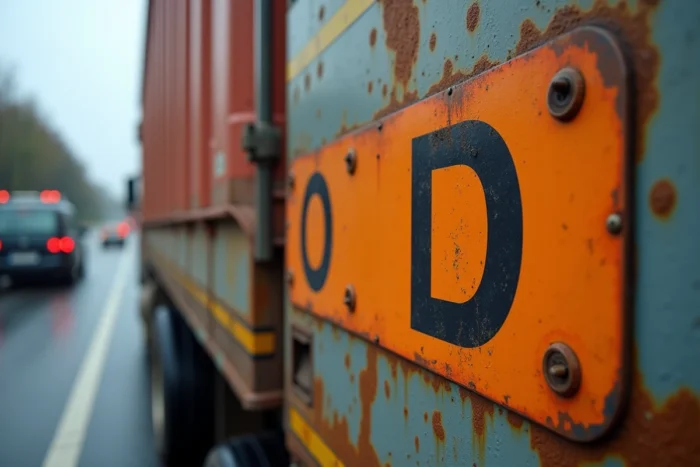
Concrete risks in case of misreading the D marking
The distinction between these markings is not academic. In real situations, a misinterpretation generates measurable risks.
During an overtaking maneuver, a driver who takes the size sign for a simple country code does not expect a vehicle wider than their lane. They engage in overtaking with insufficient lateral margin, especially on a narrow two-way road.
During a road check, the absence of the D sign on an oversized vehicle constitutes an offense. The professional driver risks having the vehicle immobilized. For a transporter, this means logistical delays and administrative penalties.
Here are some points to be vigilant about to avoid these situations:
- A black square sign with a white “D” high up always indicates a size exceeding the norm, never a country of origin
- An oval white “D” at the back is a country code; it provides no information about the vehicle’s dimensions
- On the dashboard, the “D” of the automatic transmission only concerns the mode of transmission, unrelated to external signaling
The shape of the support (square, oval, lever) identifies the function of the marking. By remembering this simple rule, reading becomes immediate. A size sign calls for increased safety distance. A country code is an administrative piece of information. The “D” for Drive exists only in the cabin. Three identical letters, three different reflexes.