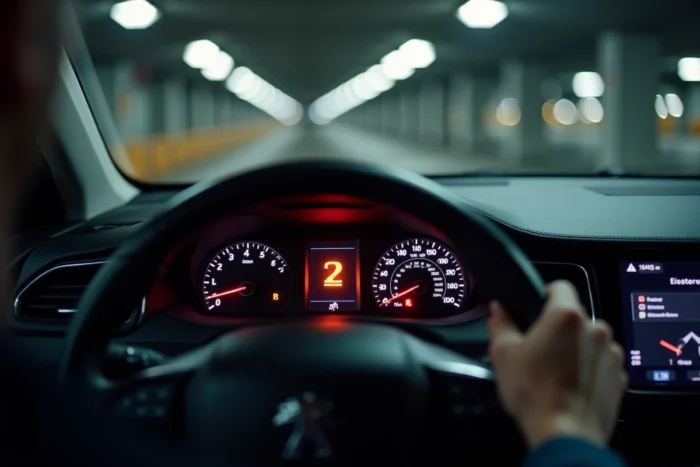
An orange warning light that lights up on the dashboard of your Peugeot 5008 is the kind of signal that abruptly interrupts the tranquility of a journey. This orange light indicates an anomaly that the vehicle’s computer has detected, without necessarily putting the engine in immediate danger. However, it’s essential to know how to read this signal to react appropriately.
Technical inspection and orange light: a regulatory constraint not to be overlooked
Have you ever noticed that a simple warning light could cause problems during the technical inspection? Since the tightening of regulations, an illuminated engine, ABS, or airbag light constitutes a reason for non-compliance. Even if the underlying problem is minor (a faulty sensor, a clogged sensor), the inspector may require a re-inspection or even immobilization of the vehicle.
This changes the game for 5008 owners. An orange light that you tolerated for weeks could block you on the day of the inspection. It’s better to address the alert beforehand rather than discovering the problem on the inspection line.
To properly identify each symbol that may appear, a detailed guide on the orange light on the Peugeot 5008 dashboard helps distinguish minor alerts from situations that require immediate stopping.
Faulty sensor or engine failure: how to tell the difference on Peugeot 5008
The electronic control unit of the Peugeot 5008 continuously monitors dozens of parameters. When a value goes outside the normal range, it lights up the orange warning light and records a fault code. The problem is that this system does not visually distinguish between a slightly drifting pressure sensor and a turbo nearing the end of its life.
Here are the most common causes, ranked by increasing severity:
- Faulty sensor or probe: lambda probe, boost pressure sensor, temperature sensor. The engine runs normally, but the computer detects an inconsistency in the measurements.
- Clogged EGR valve: common on 5008 diesel models primarily used in the city. The valve no longer closes properly, disrupting the air/exhaust gas mixture and triggering the alert.
- Saturated particulate filter (DPF): when short trips accumulate, the DPF cannot perform its regeneration. The light comes on to warn of a risk of clogging.
- Injection or turbo problem: rarer but more costly. A stuck injector or excessive play in the turbo causes a noticeable loss of power.
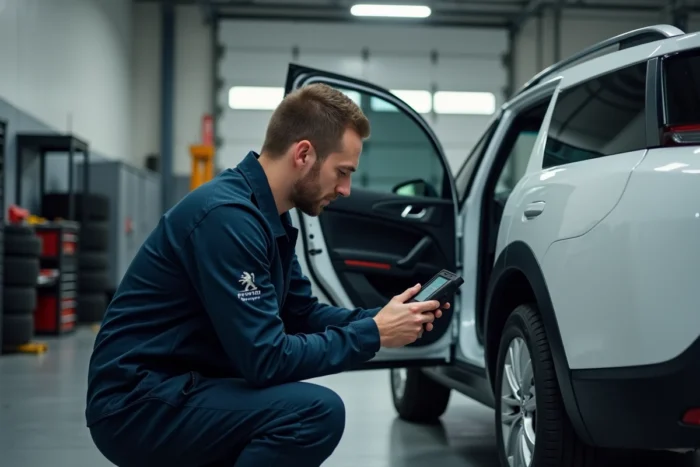
The only reliable way to determine the issue is to connect an OBD diagnostic tool to read the specific fault code. Without this reading, you are navigating blindly.
The specific case of the 1.2 PureTech engine
On petrol Peugeot 5008 models equipped with the 1.2 PureTech engine, the orange light may signal specific issues documented by Stellantis. Among them: a defective wet timing belt, abnormal oil overconsumption, or vacuum pump problems.
Recall campaigns have been launched for timing belt alignment defects on engines produced until February 17, 2024. If your 5008 is affected, the orange light may be the first visible symptom. A visit to the dealership allows you to check if your vehicle is part of the recalled batches.
Reduced mode on Peugeot 5008: what happens when the light stays on
When the computer deems the anomaly serious enough, it activates reduced mode. The principle is simple: the system intentionally limits the engine’s power to avoid worsening the situation.
In practice, you feel it immediately. Acceleration becomes sluggish, the engine speed caps out, and a message like “engine fault, please repair the vehicle” may appear on the screen. Reduced mode allows you to reach a garage, not to continue driving normally.
Ignoring this reduced mode exposes you to two concrete risks. First, progressive damage to expensive components (catalytic converter, turbo, DPF). Second, increased fuel consumption related to the degraded operation of the injection system.

Diagnosis and resolution: concrete steps in response to the orange light
The temptation to reset the light by disconnecting the battery is common. This manipulation temporarily clears the fault code but does not solve anything. The light will return as soon as the computer performs its checks again, sometimes after just a few kilometers.
What actually works
The first step is to read the fault code with a compatible OBD tool. Some entry-level readers are sufficient to identify a P0488 code (EGR valve problem) or a code related to the injection circuit. This information guides the diagnosis and avoids replacing parts at random.
Some interventions can be done without going through a professional:
- For a saturated DPF: take a prolonged highway trip at medium speed to force regeneration.
- For a clogged sensor: targeted cleaning may suffice, provided you have identified the correct sensor via the fault code.
- For low oil levels on PureTech: check the oil level every two weeks if your engine is prone to documented overconsumption.
For anything related to injection, turbo, or timing, a visit to the workshop remains the only reasonable option. The cost of a professional diagnosis is always lower than that of a blind repair.
Reading the fault code remains the action that separates a targeted repair from unnecessary parts replacement, especially on a vehicle whose electronics monitor so many parameters.