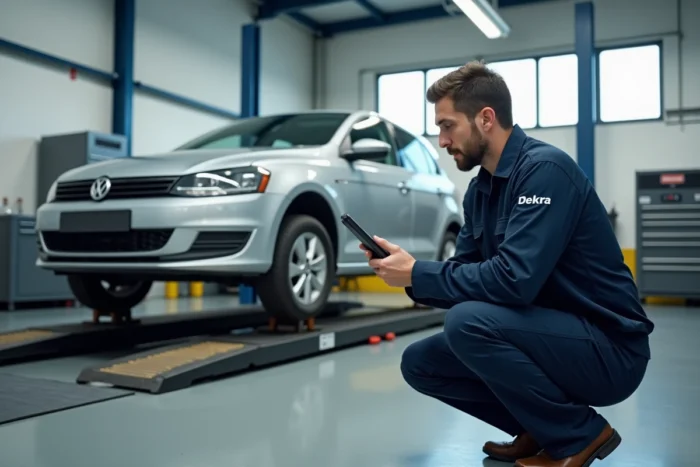
You have just booked a slot with Dekra for the technical inspection of your car. The displayed price seems correct to you. Then a re-inspection comes up, and the bill doubles. This scenario is common, but not inevitable. Understanding what causes price variations and preparing your vehicle before the visit to the center allows you to truly control the expense.
Dekra Re-inspection: The Extra Cost No One Plans for in Their Budget
The price of the technical inspection is not limited to the “initial visit” line on your invoice. When a major or critical defect is detected, you must return within two months. This re-inspection has its own cost, sometimes close to half of the initial price.
The trap is mechanical: you pay once to identify the problem, then you pay for the repair, and then you pay for a second visit to check that everything is resolved. A re-inspection turns a reasonably priced inspection into a triple expense.
Before looking for the cheapest Dekra center in your department, ask yourself a more profitable question: is your vehicle ready to pass without a hitch? By anticipating the most common reasons for refusal, you better understand the cost of the technical inspection at Dekra and avoid paying it twice.
Unresolved Manufacturer Recalls: A Commonly Overlooked Reason for Refusal
You may have received a letter from the manufacturer asking you to visit the dealership for a recall. Defective airbags, engine sensor reprogramming, corrective action on the braking system. These recalls are not mere suggestions.
An unresolved manufacturer recall can generate a major defect during the inspection. The Dekra inspector checks safety points that the recall was supposed to correct. If the corrective action has not been applied, the defect is noted, and a re-inspection is required.
The verification takes a few minutes. Visit your vehicle manufacturer’s website or contact your dealership with the VIN number. You will obtain the list of ongoing recalls and their status.
- Check the manufacturer’s website or call the dealership, providing your VIN number (visible on the registration document, box E)
- Ensure that each recall has been completed, even those received several years ago
- Keep the intervention receipts to present at the center if needed
This step costs nothing. Recalls are covered by the manufacturer. However, ignoring a recall could cost you a re-inspection and the associated repair.
ADAS Systems and Engine Lights: Modern Defects That Increase Costs
Recent vehicles come equipped with advanced driver-assistance systems (ADAS): autonomous emergency braking, lane departure warning, adaptive cruise control. These features are now inspected during the technical inspection.
Have you noticed an orange light on your dashboard for a few weeks? An illuminated ADAS light is a defect noted during the technical inspection. The inspector does not attempt to diagnose the failure; they check that the system is functioning. An illuminated light means a faulty system, thus a defect.
Warning Lights to Monitor Before Visiting Dekra
The engine light (the most well-known) is not the only issue. On equipped vehicles, the ESP light, the emergency braking light, or the blind spot monitoring system light are all potential causes for a re-inspection.
Have a mechanic read the fault codes or use an OBD scanner before your Dekra appointment. Some anomalies can be resolved with a simple reset after maintenance. Others require more extensive intervention.
It’s better to diagnose a warning light for 30 or 40 euros than to pay for a re-inspection followed by the same repair in a rush, often more expensive because the two-month deadline imposes a tight schedule.
Engine Type and Pollution: Tailoring Your Preparation to the Vehicle Type
The inspection of pollutant emissions varies depending on whether your car runs on gasoline, diesel, or electricity. This difference has a direct impact on the risk of a re-inspection.
Diesel vehicles are historically the most exposed. A clogged particulate filter (DPF) is a classic reason for refusal. If you mainly drive in the city, the DPF does not regenerate naturally.
- Diesel: take a long trip on a highway (about thirty minutes at a sustained speed) a few days before the inspection to force the DPF to regenerate
- Gasoline: check the oil level and the condition of the spark plugs, two factors that directly influence the measured emissions
- Hybrid or electric: the inspection points focus more on the braking system and the condition of the high-voltage battery, less on pollution
Adapting your preparation to the type of engine significantly reduces the risk of a re-inspection. A well-prepared diesel and a neglected diesel do not yield the same results on the analysis bench at all.
The Specific Case of Automatic Transmission Vehicles
Automatic transmissions can mask jolts or abnormal behaviors that the driver no longer perceives due to habit. The inspector, however, detects them during the inspection of the suspension and transmission. A low transmission fluid level or a never-performed fluid change can cause visible anomalies during the examination.
Dekra Offers and Packages: What Really Affects the Price
Dekra, Norisko, and Autocontrol (the three brands in the network) offer packages that vary by center. The price displayed online when booking is not always the same as the one practiced at the counter.
Booking online on the Dekra-Norisko site generally provides access to a preferential rate. Some centers also offer packages that include the re-inspection, which neutralizes the financial risk we just described.
A package including the re-inspection can be more cost-effective than the base rate alone. This calculation depends on the condition of your vehicle. If you have doubts about a control point, the package becomes a concrete insurance.
Partnerships also exist. BlaBlaCar, for example, offers a discount to carpoolers at participating Dekra network centers. The promotional code is applied during online booking or directly at the center.
The real lever for optimizing the cost of the technical inspection at Dekra is not found in comparing prices between centers. It is found in the preparation of the vehicle. A successful inspection on the first try remains, by far, the cheapest scenario.