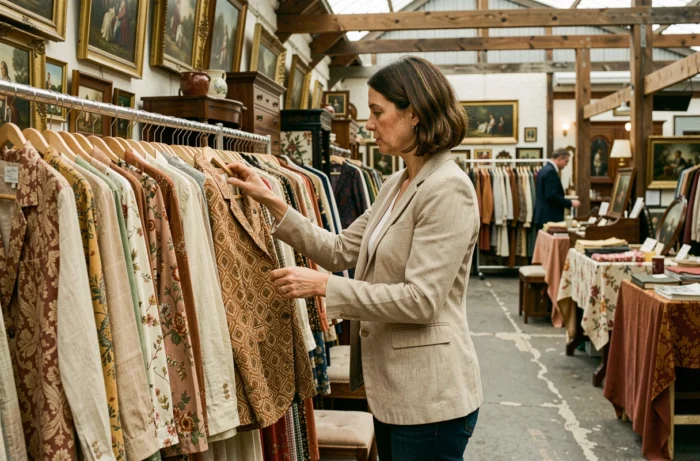
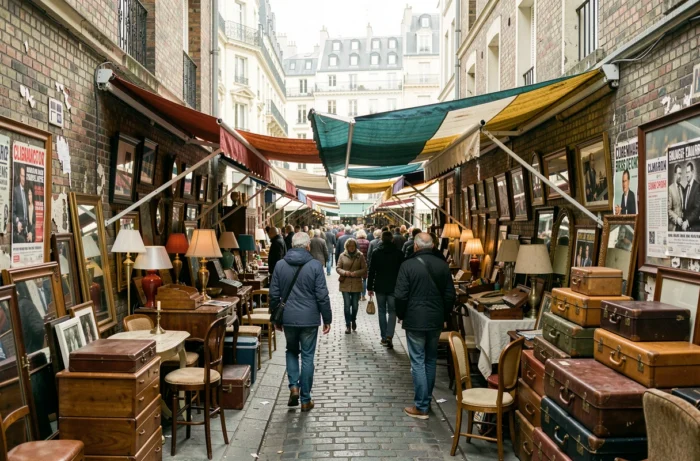
The Paris Saint-Ouen Flea Market, accessible from the Porte de Clignancourt, brings together eleven covered markets and five shopping streets over seven hectares. With over 2,000 vendors and an annual attendance exceeding five million visitors, this site represents the largest concentration of antique dealers and second-hand sellers in the world. However, the prices vary significantly depending on the type of item sought, the market visited, and the time of the visit.
Price Ranges by Item Category at the Saint-Ouen Flea Market
The price gap between a small decorative item and a collectible piece of furniture can range from simple to a hundredfold. Understanding this stratification helps to calibrate one’s budget before heading out.
| Category | Indicative Price Range | Examples of Items |
|---|---|---|
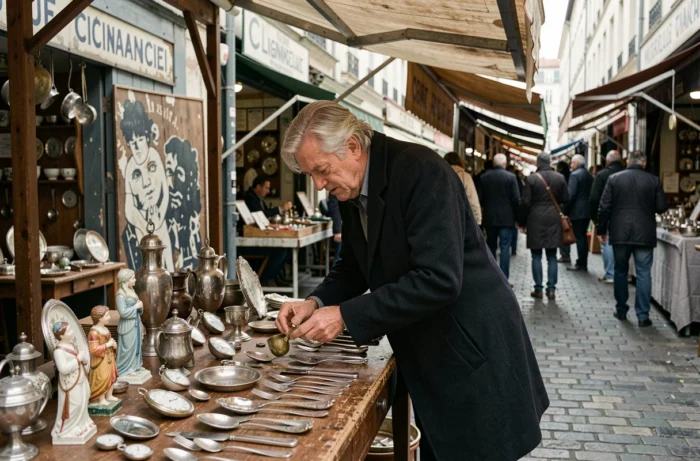
| Small decorative items and common collectibles | around 10 to 50 euros | Old postcards, retro tableware, trinkets, metal boxes |
| Quality vintage fashion | starting from around thirty euros, up to a hundred | Designer jackets, leather bags, branded dresses from past decades |
| Antiques and collectible furniture | from a few hundred to several thousand euros | Art Deco dressers, signed bronzes, industrial lighting |
This table reflects the trends reported for 2026 by specialized guides on the Paris flea markets. Therefore, small budgets can find satisfaction in common decorative items, while knowledgeable collectors should plan for a significantly larger envelope for rare pieces.
For those interested in the prices of shops in Clignancourt, this segmentation serves as the first reliable reference before wandering through the aisles.
Malik Market and Streetwear: The Budget Segment That Guides Overlook
Most online content emphasizes the antique and second-hand aspect of the Flea Market. Malik Market, however, has established itself as a hub dedicated to streetwear and accessible thrift. Its origins date back to the 1940s when second-hand military uniforms were sold there.
Today, Malik focuses on sportswear, second-hand sneakers, and urban fashion accessories at prices starting well below thirty euros. It is the most affordable market at the Flea Market for fashion.
However, the quality and authenticity of the items can be more uneven than in the specialized covered markets. A savvy buyer takes the time to check seams, labels, and materials before negotiating.
Covered Markets at Clignancourt: Specialties and Pricing Positioning
The eleven covered markets at the Flea Market are not equal in terms of range or specialty. Identifying the right market for the right item helps avoid wasting time and money.
High-End Markets: Biron, Serpette, Paul Bert
These three markets gather established antique dealers, often listed in auction catalogs. Here you can find 18th-century furniture, signed bronzes (such as works by Mathurin Moreau), designer lighting, and antique jewelry. Prices rarely start below a few hundred euros and can easily reach several thousand for documented pieces.
Mid-Range Markets: Dauphine and Vernaison
Dauphine Market, with its two levels, mixes old books, vinyl records, movie posters, and vintage fashion. Vernaison, the oldest of the Flea Market markets, offers an eclectic mix of second-hand goods, industrial items, and curiosities at more accessible prices.
- Dauphine is suitable for enthusiasts of rare books, records, and pop culture items, with prices often ranging between ten and several hundred euros depending on rarity.
- Vernaison attracts treasure hunters looking for industrial furniture, antique tableware, or textiles, in a more informal atmosphere.
- L’Entrepôt and Jules-Vallès offer larger spaces for bulky furniture, with recovered pieces at varying prices.
Negotiation and Buying Strategy at the Clignancourt Flea Market
The prices displayed at the Flea Market are not fixed. Negotiation is part of the culture of the place, but its effectiveness depends on several concrete factors.
The margin for negotiation varies depending on the market and the type of seller. The second-hand sellers at Vernaison or Malik are more likely to accept a price discussion than the antique dealers at Biron, whose pieces are often appraised and documented.
The timing of the visit also plays a role. The markets are open from Friday to Monday, with differing hours: Friday from 10 AM to 1 PM, Saturday and Sunday from 10 AM to 6 PM, and Monday from 11 AM to 5 PM. Monday late in the day is often conducive to the best discounts, as sellers prefer to lighten their stock before the weekly closure.
- Arriving early on Saturday morning allows you to spot pieces before the crowds, but sellers are less inclined to lower their prices at the beginning of the weekend.
- Paying in cash facilitates negotiation at small stands, where terminal fees weigh on margins.
- Comparing prices between markets for the same type of item (industrial lamp, vintage armchair) provides a concrete leverage for discussion.
The fifth most visited tourist site in France remains a place where shopping requires preparation. Knowing the segmentation of the markets, the price ranges by category, and the most favorable time slots transforms a simple stroll into a well-managed treasure hunt. The average budget to plan depends less on luck than on knowledge of the terrain.