
You spotted a hand-dyed fabric at a market, a ceramic piece in an Instagram story, or a brass jewelry item on a marketplace. The desire is there, but taking action often stalls at the same point: how to reach the person who makes it, ask the right questions, and get a useful response?
Contacting a creative artisan shop doesn’t work like sending a message to a traditional brand. The channel, timing, and wording change the game.
Contact form or direct message: choosing the right channel for an artisan shop
An artisan who manages their production, shipping, and communication alone doesn’t monitor all their channels with the same regularity. The common reflex is to send a private message on Instagram or Facebook, but the website form remains the most reliable channel for getting a structured response.
On social media, messages get lost among notifications of likes, comments, and collaboration requests. The contact form, on the other hand, arrives in a dedicated inbox, often linked to a tracking tool. You can detail your request, specify dimensions, or attach a reference photo without character limits.
For a shop that offers custom handmade creations, reaching out through their own website is advantageous. This is especially true when you want to discover the site Le Terrier De Lily and access a space designed to gather personalized requests directly.
If the shop doesn’t display a form, an email is preferable to a DM. You can structure your request better, keep a record, and the artisan can respond thoughtfully between production sessions.

Preparing your request before writing: the information an artisan really expects
A creator regularly receives vague messages like “Hello, how much is it?” without context. Such requests prolong exchanges because follow-ups are needed to obtain every detail. A precise message from the first contact halves the response time.
Before writing, gather some concrete elements:
- The type of product or creation you are interested in, with a visual reference if possible (link to the product page, screenshot, inspiration photo)
- The intended use: gift, personal decoration, bulk order for an event, or simply a question about materials
- The time constraints: deadline for delivery, upcoming event, or lack of urgency (specifying this helps too)
- The approximate budget you have in mind, even if expressed as a wide range
This list may seem simple, but it saves time on both sides. An artisan who receives this information can respond with a quote or a concrete proposal right from the first reply.
Mentioning your customization desires from the start
Many creative shops offer custom options: color choices, engraving, dimension adjustments. If this interests you, bring it up in the first message. Waiting until the third exchange to say “actually, I would like a different size” restarts the entire pricing process.
Responses vary on this point, but several artisan shops indicate on their site the customizations that are possible and those that are not. Reading the product page or FAQ before writing avoids unnecessary back-and-forth.
Response times and follow-ups: what is normal for a creative shop
You don’t contact an artisan shop like you write to the customer service of a large brand. A response time of three to five business days is not unusual for a creator who splits their time between making, online sales, and markets.
Following up after 48 hours is too soon. Following up after ten days without a response is reasonable. Between the two, patience is key. If you have a tight deadline, mention it clearly in your initial message rather than sending three successive follow-ups.
Timing your message
Peak activity periods for creative artisans coincide with the holiday season, Mother’s Day, and back-to-school time. During these peaks, response times naturally lengthen. Contacting a shop ahead of these periods, rather than in the middle of a rush, significantly increases your chances of getting a quick response.
This anticipation also affects availability for custom work, which is often suspended during high season.
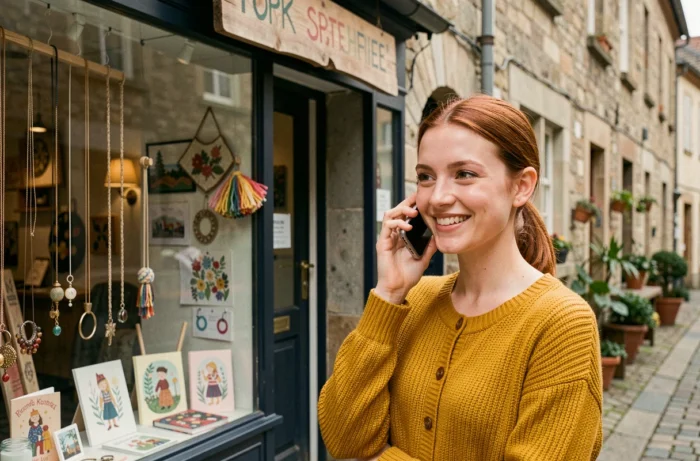
Local creative shops and concept stores: adapting your approach based on the format
Not all artisan shops operate the same way. A workshop-shop run by a single creator, a collaborative consignment shop, and a multi-brand concept store do not have the same decision-making processes or contact channels.
The 2025 Independent Commerce Observatory by Ankorstore notes that independent businesses are refocusing on European and local sourcing. This trend encourages creative shops to emphasize the traceability of their products. When you contact them, asking questions about the origin of materials or the place of production shows genuine interest, not distrust.
In a concept store, your contact may not necessarily be the creator. The manager selects brands and can direct you to the artisan if your request concerns customization. Always specify the name of the product or brand you are interested in so that the message reaches the right person.
Moving from first contact to custom purchase
Once the response is received, the next steps depend on the type of creation. For an in-stock product, the transaction is direct. For a custom order, expect an exchange in two or three steps: project validation, confirmation of price and timeline, then deposit.
Requesting a written summary before finalizing protects both parties. An email summarizing the specifications, final price, and expected delivery date is sufficient. No need for a formal contract for a typical artisan order, but this written record avoids misunderstandings.
Contacting a creative shop, at its core, is based on a simple principle: treat the artisan as a professional interlocutor, not as a seller waiting. A clear message, sent to the right place, with the right information, transforms mere curiosity into a concrete project much faster than a series of fragmented messages across three different platforms.